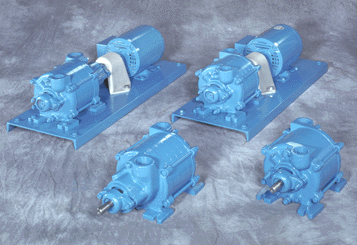
Regenerative Turbine Pumps

Log in to view price

Flexible Coupled

Capacities to 60 GPM

Heads to 800 Feet

Low NPSH Requirements on 240 • 280 Series

140 • 240 • 180 • 280 Series regenerative turbine pumps represent the most economical, high performance alternative for low flow (to 55 GPM) applications involving moderate to high pressures (heads to 700 feet). By combining years of regenerative turbine pump designs with precision computer controlled manufacturing, the 140 • 240 • 180 • 280 Series delivers high efficiency pumping operation, even at low NPSH. High quality parts and an easily serviceable design provide low maintenance and long life.

[lollum_button text=»Detail Downloads» url=»www.google.com» size=»medium»]

Regenerative Turbine Pumps

Water Passage Design

MTH has combined sixty years of water passage design with a multistage mechanical concept to achieve maximum capacity and pressure while minimizing horsepower requirements. By optimizing the number of pumping stages with each water passageway, MTH improves both efficiency and pressure in the 140 • 240 • 180 • 280 Series, exceeding the standards realized by previous techniques.

Typical Applications:
Hot Water Pumping
Low NPSH
Boiler feed service

Water Passage Design
MTH masters one of the most critical design considerations for regenerative
turbine pumps — the shaping of water passageways to achieve
highest capacity and pressure while minimizing horsepower requirements.
By optimizing water passageway cross-sectional profiles for each impeller, MTH has improved both
efficiency and pressure in the T51 • E51 Series, and exceeds the levels, realized by previous techniques.

Impeller Profile
One of the most notable improvements in regenerative turbine pump technology incorporated in T51
• E51 Series pumps involves the ability to determine the optimum
impeller width and blade length. These factors have a significant effect on the required horsepower versus
pressure curve for regenerative turbine pumps. By optimizing these for each T51 • E51 Series pump, peak efficiency is improved and “off
peak” horsepower requirements are reduced as well.

Specs

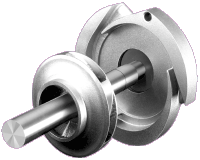
Impeller Profile One of the most notable improvements in regenerative turbine pump technology incorporated in 140 • 240 • 180 • 280 Series pumps involves the ability to determine the optimum impeller width and blade length. These factors have a significant effect on the required horsepower versus pressure curve for regenerative turbine pumps. By optimizing these for each 140 • 240 • 180 • 280 Series pump, peak efficiency is improved and “off peak” horsepower requirements are reduced as well.

Impeller

Impeller Blades After the most favorable impeller profile has been determined for a particular water passageway cross-section, MTH calculates the number of blades needed to maximize the performance of that pump. Current blade design in 140 • 240 • 180 • 280 Series pumps increases both efficiency and design pressure without the manufacturing difficulties associated with producing contoured blade impellers. State-of-the-art computer controlled machines simplify manufacturing of the various MTH impellers utilized in the 140 • 240 • 180 • 280 Series. The result is a high performance pump providing efficiency characteristics exceeding those of more expensive units.

NPSH Requirements

NPSH Requirements 140 • 240 • 180 • 280 Series regenerative turbine pumps meet low net positive suction head (NPSH) requirements without efficiency loss. This is achieved by keeping the inlet fluid velocity low and then gently accelerating to passageway velocities. 200 Series Inducer for Low NPSH 240 • 280 Series regenerative turbine pumps provide exceptionally low NPSH requirements to suit boiler feed water deaerator applications. This reduced NPSH is obtained by using a first stage centrifugal Francis vane impeller with inlet flow paths shaped to maintain a constant fluid velocity. This reduces entry losses to the impeller as well as maintaining pump efficiency. A multi-vane diffuser is used in conjunction with the centrifugal impeller for balancing radial loads and extracting the maximum pressure from the flow produced by the first stage impeller. Pressure and flow produced by the low NPSH inducer assures that the succeeding stages are adequately fed.

Call Now Button